

How MOQ Affects Custom Rigid Box Manufacturing Costs
In the world of premium packaging, MOQ (Minimum Order Quantity) is one of the most important factors influencing production costs. Businesses sourcing Custom Rigid Boxes often focus on materials, printing quality, and design features, but the order quantity itself can significantly impact the final price per unit.
Understanding how MOQ affects manufacturing costs helps brands make smarter purchasing decisions, improve packaging budgets, and maximize return on investment. Whether a company is launching a new product line or scaling an established brand, MOQ plays a crucial role in determining overall packaging efficiency.
Understanding MOQ in Custom Rigid Box Manufacturing
MOQ refers to the minimum quantity of packaging units a manufacturer is willing to produce in a single production run. In the case of Custom Rigid Boxes, MOQ requirements are typically higher than those of folding cartons because rigid box production involves more labor-intensive processes, specialized equipment, and premium materials.
Manufacturers establish MOQ levels to ensure that production remains economically viable. Before any box enters mass production, several preparation steps must be completed, including structural design verification, die creation, printing plate setup, machine calibration, color matching, sample production, and quality inspections. These processes generate costs regardless of whether the order consists of 500 boxes or 50,000 boxes.
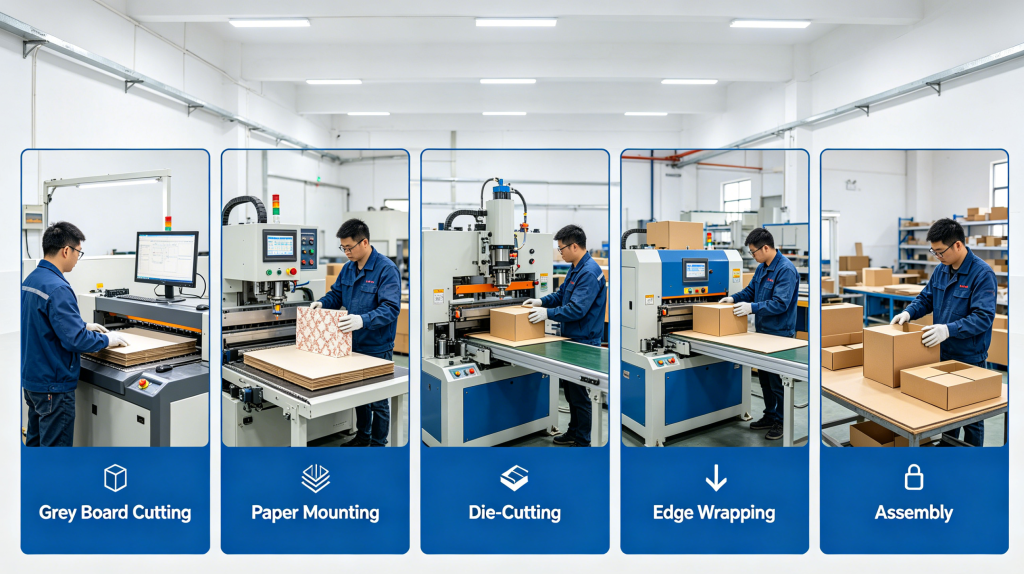
As a result, MOQ helps distribute these upfront expenses across the entire production volume.
The Relationship Between Fixed Costs and MOQ
To understand why MOQ affects pricing, it is essential to examine the cost structure of rigid box manufacturing.
Production costs generally fall into two categories: fixed costs and variable costs.
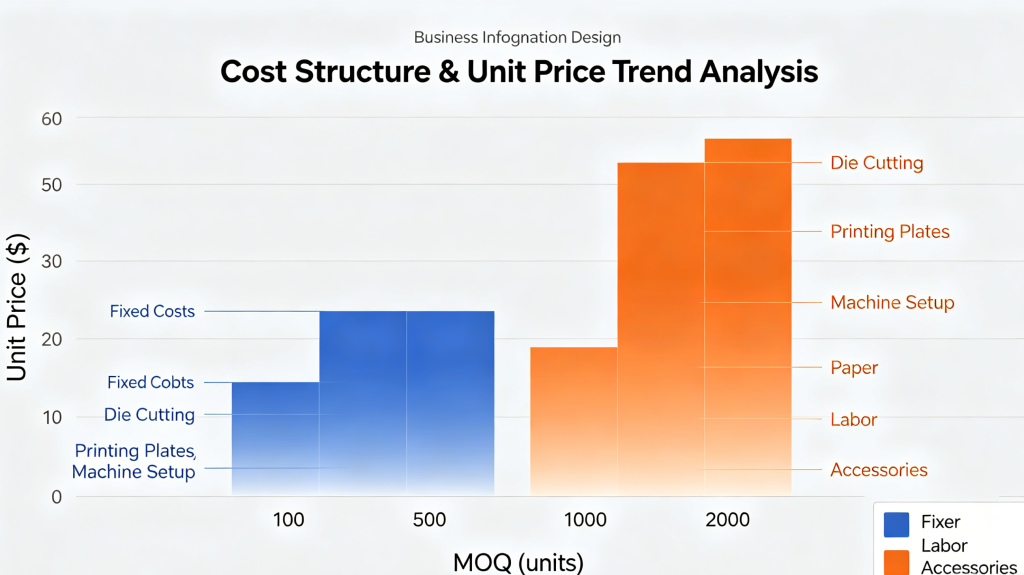
Fixed costs include tooling, die-cutting molds, printing plate creation, machine setup, proofing, and production preparation. These expenses remain relatively constant regardless of production quantity.
Variable costs include paperboard, specialty paper wraps, magnetic closures, ribbon pulls, inserts, printing ink, labor, assembly, and shipping. These costs increase as production volume grows.
When MOQ is low, fixed costs are spread across fewer units, causing the cost per box to rise significantly. When production volume increases, those same fixed costs are distributed across thousands of units, lowering the per-unit manufacturing cost.
This principle explains why larger orders often receive substantially better pricing than smaller production runs.
Why Small MOQ Orders Cost More
Many buyers are surprised when they receive quotations showing a much higher unit price for small orders. The reason lies in manufacturing efficiency.
For example, producing 500 Custom Rigid Boxes may require the same setup procedures as producing 5,000 units. The printing plates, die-cutting tools, and machine preparation remain virtually identical. Since these setup expenses must be recovered by the manufacturer, each box in a smaller production run absorbs a larger share of those costs.
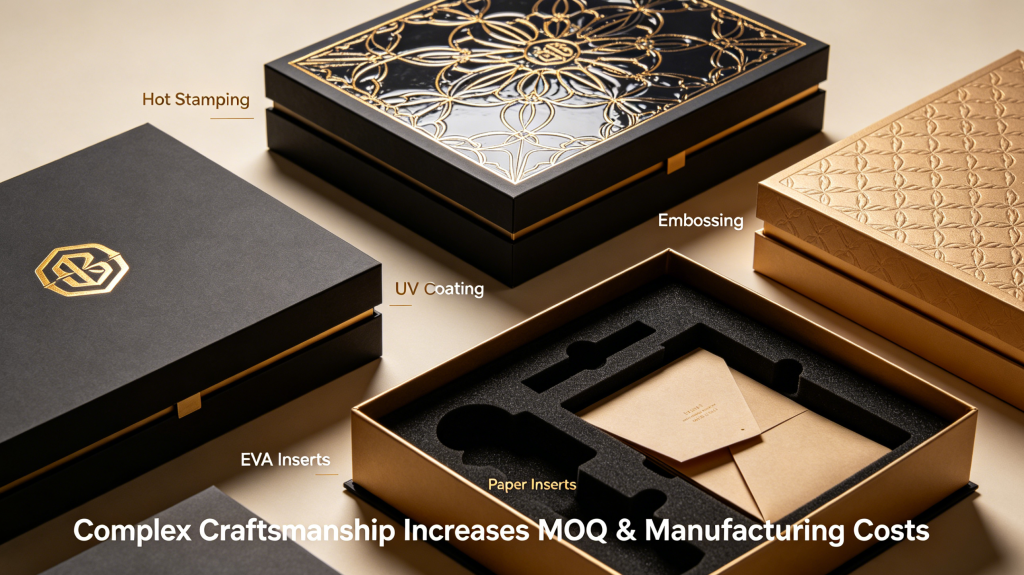
In addition, smaller orders often create production inefficiencies. Material utilization may be lower, machine downtime may increase, and labor costs become less optimized. Premium finishing techniques such as foil stamping, embossing, debossing, spot UV, or soft-touch lamination can further amplify these effects because each process requires additional setup time and equipment preparation.
As a result, low-volume projects generally experience higher unit costs compared with larger production runs.
How Product Design Influences MOQ Requirements
Not all rigid boxes share the same MOQ requirements. Box structure, material selection, and decorative finishes can significantly affect manufacturing economics.
Simple Custom Rigid Boxes with standard dimensions and conventional printing are generally easier to manufacture and may qualify for lower MOQs. However, luxury packaging featuring magnetic closures, custom inserts, ribbon pulls, textured specialty papers, or multi-level embossing often requires higher production quantities.
Premium materials can also influence MOQ. Certain specialty papers and decorative coverings may only be available through bulk purchasing arrangements from suppliers. When manufacturers must purchase large quantities of material to complete a project, minimum order requirements naturally increase.
Therefore, packaging complexity directly impacts both MOQ and overall manufacturing cost.
Strategies for Reducing Custom Rigid Box Costs
Although MOQ cannot always be eliminated, brands can adopt several strategies to improve cost efficiency.
One effective approach is standardizing box dimensions whenever possible. Using commonly available sizes often reduces tooling expenses and improves material utilization.
Another strategy involves simplifying decorative finishes. While foil stamping, embossing, and specialty coatings enhance luxury appeal, reducing the number of finishing processes can significantly lower production costs.
Brands launching new products may also consider phased packaging programs. Starting with a moderate MOQ allows companies to test market demand before committing to larger production volumes.
Working with an experienced rigid box manufacturer is equally important. A knowledgeable supplier can recommend material alternatives, optimize structural designs, and identify production efficiencies that reduce overall packaging expenses without compromising product presentation.
Long-Term Benefits of Higher MOQ Orders
Although larger orders require greater upfront investment, they often deliver substantial long-term advantages. Lower unit costs improve profit margins, while consistent packaging availability supports uninterrupted product distribution.
Higher-volume production also enables brands to achieve greater design consistency, maintain stable quality standards, and reduce the frequency of reordering cycles. For businesses with predictable sales forecasts, larger MOQ orders often represent the most cost-effective packaging solution.
Furthermore, establishing long-term partnerships with experienced manufacturers can create opportunities for improved pricing, streamlined production scheduling, and greater flexibility on future projects.
Conclusion
MOQ remains one of the most influential factors in Custom Rigid Box manufacturing costs. Because rigid box production involves significant setup expenses, order quantity directly affects how those costs are allocated across each unit. Smaller orders provide flexibility but typically result in higher unit prices, while larger production runs benefit from economies of scale and improved manufacturing efficiency.
By understanding the relationship between MOQ, production setup costs, materials, and manufacturing processes, businesses can make informed purchasing decisions and develop packaging strategies that balance quality, branding, and cost control. Choosing the right Rigid Box Packaging supplier and planning order quantities strategically can significantly improve packaging profitability while maintaining premium product presentation.