

Custom Rigid Box Packaging vs Folding Cartons: Which Is Better?
When a brand faces the choice between custom rigid box packaging and folding cartons, the decision goes far beyond simple cost comparison. Both options serve the fundamental purpose of containing and protecting a product, yet they deliver vastly different experiences, structural integrity, and brand perceptions. Understanding the strengths and limitations of each is essential for any business that views packaging as a strategic asset rather than an afterthought.
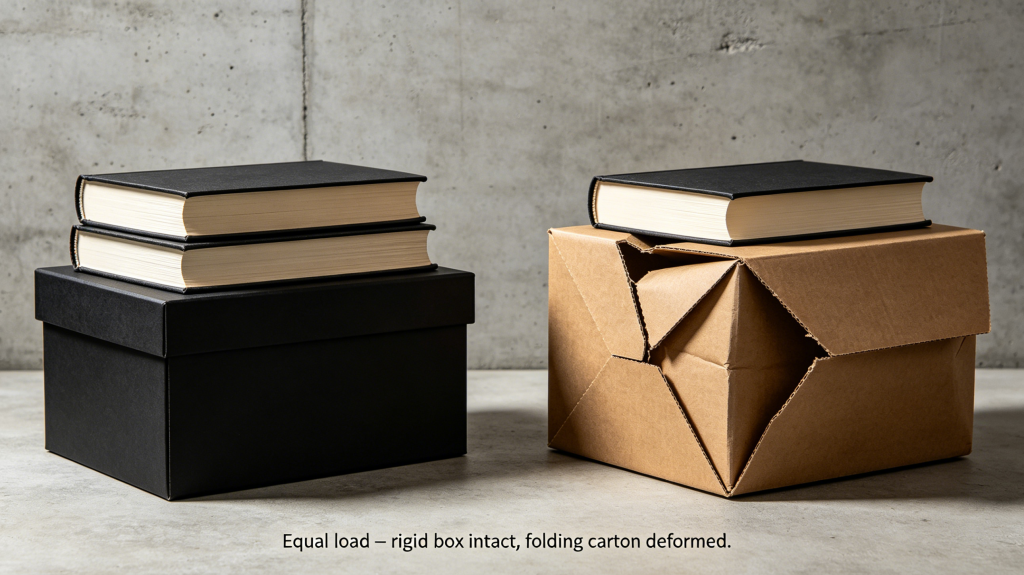
Rigid boxes, often referred to as set‑up boxes, are constructed from thick, high‑density paperboard that is wrapped around a solid chipboard core. This construction gives them exceptional stiffness and crush resistance. The box does not collapse or fold flat; it arrives fully assembled and retains its shape under significant pressure. Folding cartons, by contrast, are made from thinner paperboard (typically 12pt to 24pt) that is scored, cut, and folded into shape. This fundamental difference in material thickness and construction drives every other distinction between the two formats.
A rigid box can withstand stacking, shipping vibrations, and accidental drops without transferring force to the product inside. Luxury watches, smartphones, fine chocolates, and high‑end cosmetics almost exclusively use rigid boxes because a dented corner or a crushed lid would instantly devalue the item’s perceived quality. Folding cartons offer adequate protection for lightweight, non‑fragile goods such as over‑the‑counter medications, breakfast cereals, or basic household items. However, once a folding carton is subjected to moderate compression, its corners easily bend, and the structure can fail.
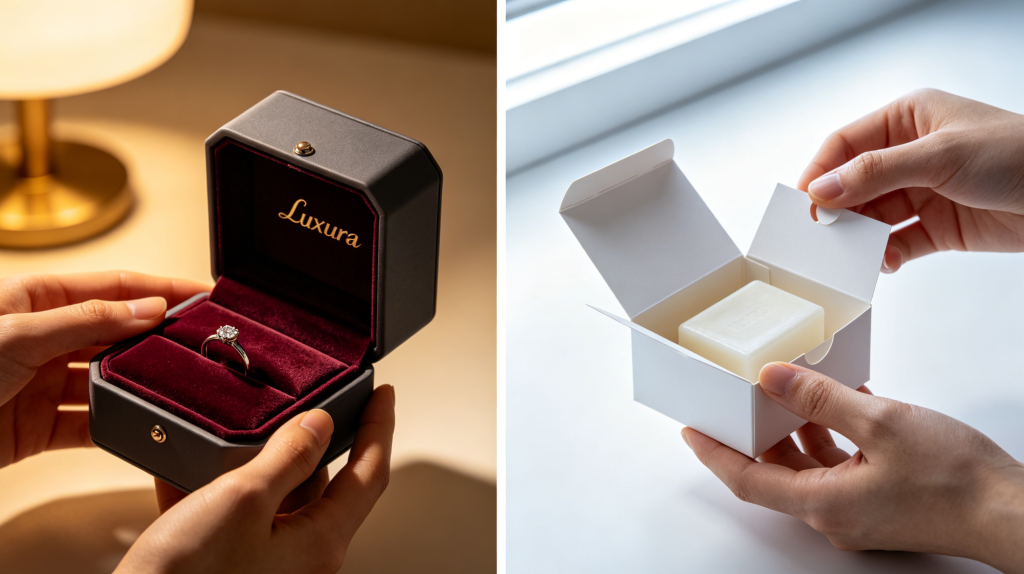
The unboxing experience tells another dramatic story. Rigid boxes open with a satisfying weight and a smooth magnetic or friction‑fit closure. The interior can be lined with premium materials like velvet, leatherette, or custom‑printed foam. Lifting a product out of a rigid box feels ceremonial and memorable – exactly what luxury brands want to evoke. Folding cartons typically offer a simpler opening: either a tuck flap, a glue‑sealed end, or a perforated tear strip. While printing on folding cartons can be beautiful, the tactile sensation remains lightweight and less substantial. For e‑commerce brands that rely on customer‑generated unboxing videos, a rigid box is far more likely to be shared on social media.
Cost and logistics present the main advantages of folding cartons. Producing a folding carton consumes less material and can be run at extremely high speeds on automated lines. Storage and transport are cheaper because folding cartons ship flat, with up to 10 times as many units fitting into the same truck or warehouse shelf. Rigid boxes are bulkier to store and cost more to manufacture due to the thicker board, additional assembly steps, and often manual or semi‑manual labor. Therefore, for mass‑market products with thin margins and high turnover, folding cartons remain the practical choice.
Sustainability considerations are evolving rapidly. Historically, folding cartons were seen as greener because they use less fiber. However, modern rigid boxes can be made from recycled chipboard and printed with water‑based inks. Some suppliers now offer rigid boxes with biodegradable coatings and zero‑plastic components. Because rigid boxes are more likely to be kept and reused by consumers (as storage or gift boxes), their life cycle can actually extend beyond a single use. Folding cartons are usually recycled after opening. Neither is inherently superior without examining the full supply chain, but brands committed to circular design can succeed with either format.
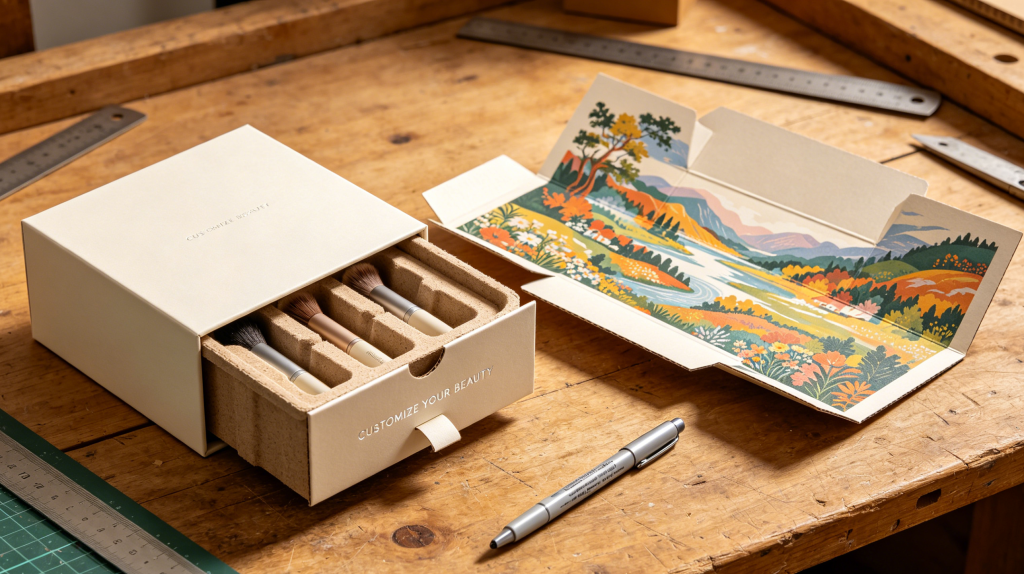
Customization capabilities differ as well. Both types allow for offset printing, foil stamping, embossing, and spot UV. Yet rigid boxes offer additional structural possibilities: drawers, hinged lids, ribbon pulls, magnetic closures, and foam inserts. These features are difficult or impossible to achieve with folding cartons. For a brand that needs to communicate craftsmanship and attention to detail, a custom rigid box provides a three‑dimensional canvas that folding cartons simply cannot match.
So which is better? The answer depends entirely on the product’s value, weight, fragility, and the intended brand positioning. For luxury goods, electronics, jewelry, high‑end spirits, or any product where the packaging directly influences the perceived price, custom rigid box packaging is unquestionably superior. For everyday consumables, budget‑friendly items, or products sold primarily on price, folding cartons are the smarter economic choice. Many brands even use a hybrid strategy: a folding carton for retail shelf display, combined with a rigid box for limited editions or direct‑to‑consumer gift sets. Ultimately, the best packaging is not the one that costs less, but the one that earns more through protection, presentation, and customer delight.